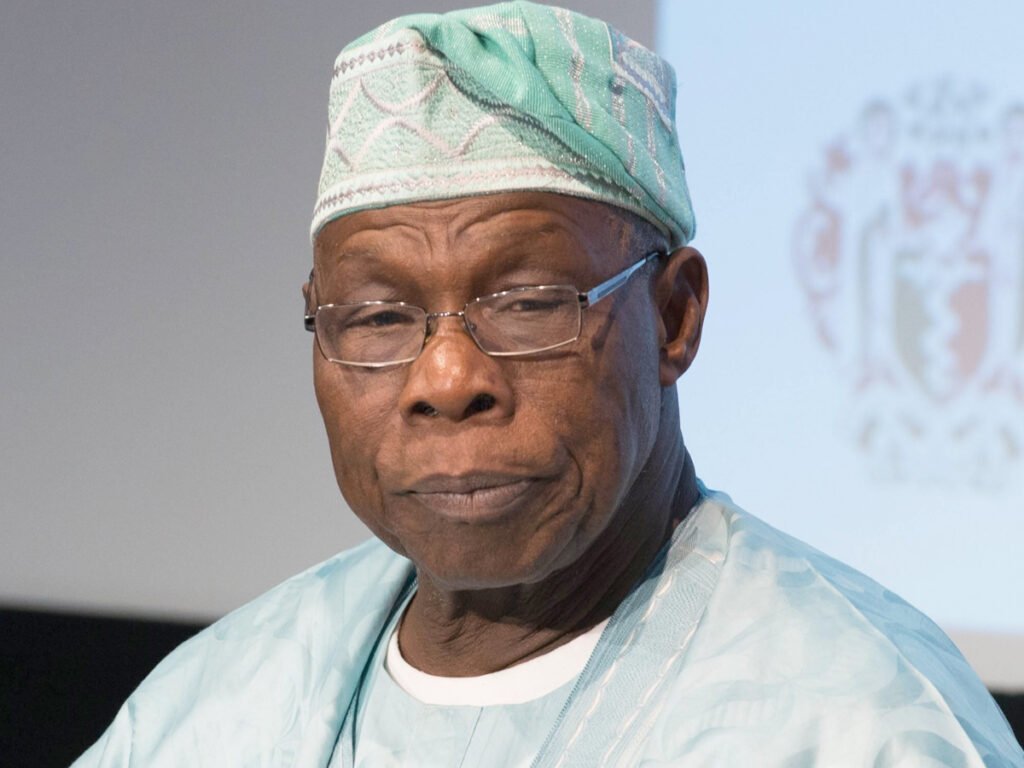

Former President Olusegun Obasanjo has called on the Federal Government to abandon negotiations with terrorists, insisting that decisive action, including international assistance, is necessary to confront Nigeria’s escalating insecurity.
Obasanjo spoke on Friday at the Plateau State Unity Christmas Carol and Praise Festival in Jos, the state capital, expressing concern over the rising number of abductions, killings, and attacks across several northern and central states in recent weeks.
“No matter what religion you belong to, no matter where you come from, no matter your profession, we Nigerians are being killed, and our government seems incapable of protecting us,” Obasanjo said.
“We are part of the world community, and if our government cannot do it, we have the right to call on the international community to do for us what our government cannot do for us,” he added.
The former president emphasised that modern technology, including drones, now makes it possible to locate and neutralise criminals without the logistical constraints that existed during his tenure.
He questioned why such capacities are not being utilised effectively and why the government continues to apologise and negotiate with terrorists.
Obasanjo’s remarks follow a series of high-profile attacks and abductions that have shaken the country.
On November 21, 315 students and 13 teachers were abducted from St Mary’s Catholic School in Papiri, Niger State. This came days after the kidnapping of 26 schoolgirls from Government Girls Secondary School, Maga, in Danko-Wasagu Local Government Area of Kebbi State, on November 17.
In addition, bandits struck the Palaita community, Erena Ward, Shiroro Local Government Area of Niger State, abducting 24 people, including pregnant women, from a rice farm.
Kano and Kwara states also reported the abduction of approximately 20 people between Monday night and Tuesday morning.
These recent events followed the November 18 abduction of 38 worshippers from the Christ Apostolic Church, Oke-Isegun, Eruku, Ikere, Kwara State. Those victims were released after negotiations by the Federal Government, highlighting the very approach Obasanjo criticised.
Other attacks have been reported in Isapa, Kwara State, where 10 persons, including a pregnant woman, nursing mothers, and children, were abducted. Similar incidents across Zamfara, Sokoto, and Yobe states have contributed to what analysts describe as a rapid deterioration of security in northern Nigeria.
Obasanjo stressed that the government’s failure to adequately protect citizens is forcing Nigerians to consider international intervention. He urged authorities to leverage technological tools and modern intelligence to dismantle terrorist networks, arguing that the country now possesses the capacity to apprehend criminals effectively.
The Federal Government has responded to the growing insecurity with various measures. On Wednesday, President Bola Tinubu declared a national security emergency and ordered the immediate recruitment of additional security personnel to bolster the nation’s defences.
Despite these steps, critics argue that responses remain reactive rather than preventive, and the continued targeting of schools, farms, and places of worship underscores the urgent need for comprehensive security reform.
Kidnappings in Nigeria, particularly in the north-west and north-central regions, have become increasingly sophisticated, with attackers exploiting remote locations and weak law enforcement presence. Since the 2014 Chibok schoolgirls kidnapping, over 2,400 students have been abducted in more than 90 separate incidents, illustrating a long-term pattern that has worsened in recent years.
“The government must take a firm stance and stop treating negotiations as a solution. Our security agencies must be empowered and allowed to operate efficiently, and if necessary, we must seek support from the international community to ensure the safety of Nigerians,” Obasanjo added.