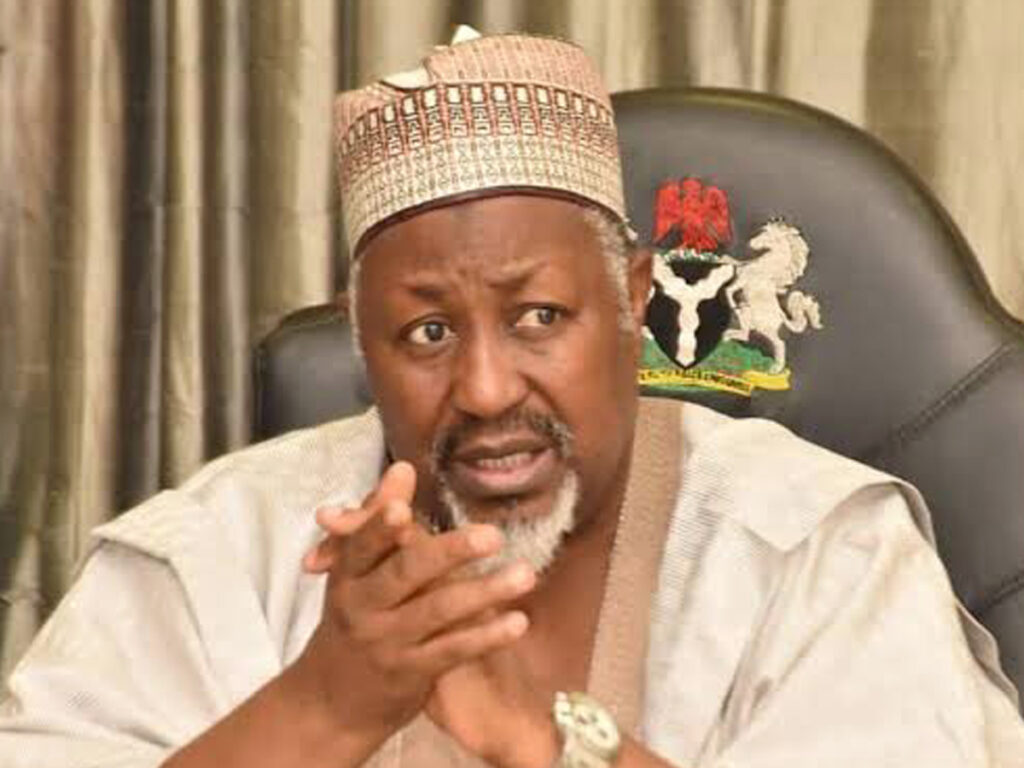

Nigeria’s Minister of Defence, Mohammed Badaru Abubakar, has resigned from his post with immediate effect, citing health reasons.
The announcement was made late Monday in a statement by Bayo Onanuga, Special Adviser on Information and Strategy to President Bola Tinubu.
According to the statement, Badaru submitted a formal resignation letter dated December 1, addressed to President Tinubu, in which he disclosed that health concerns necessitated his departure.
The President accepted the resignation, commending Badaru for his service to the nation, and is expected to inform the Senate of his successor later this week.
The 63-year-old minister served as a two-term governor of Jigawa State from 2015 to 2023 before his appointment as Defence Minister on August 21, 2023. He holds a degree in accounting from Ahmadu Bello University, Zaria, and is an alumnus of the National Institute for Policy and Strategic Studies (NIPSS), Kuru.
Prior to his political career, Badaru also had a notable business career, holding leadership positions in major national business associations.
Badaru’s resignation comes at a critical juncture for the Tinubu administration, which is grappling with escalating insecurity across several northern states.
In recent weeks, Nigeria has witnessed a surge in violent incidents, including the kidnapping of 25 students in Kebbi State and about 300 students in Niger State.
Bandit attacks have also been reported in Sokoto, Kogi, and Kwara states, while armed assailants kidnapped at least 10 people, including a bride and her companions, in Sokoto.
A pastor and his wife were abducted in Kogi State, and three officials of the Nigeria Immigration Service were killed at a checkpoint in Katsina State.
The heightened insecurity has prompted President Tinubu to declare a nationwide security emergency, accompanied by measures such as the recruitment of 20,000 additional police officers, deployment of forest guards, and the strengthening of security for schools, churches, and mosques in vulnerable areas.
Despite these steps, some analysts had repeatedly called for Badaru’s removal, questioning his capacity to lead the Defence Ministry amid worsening security challenges.
Hours before the resignation announcement, Tinubu held a private meeting with former Chief of Defence Staff, Gen. Christopher Musa (retd.), at the State House. Musa, who retired in October 2025, arrived at 7:03 p.m., dressed in northern-style traditional attire, and was escorted to the President’s office wing.
While the purpose of the meeting has not been officially confirmed, it has fueled speculation about the appointment of a new Defence Minister and possible broader security reshuffles.
In a recent interview, Badaru maintained that security agencies were working “day and night” to confront the resurgence of school kidnappings and other criminal activities.
Nevertheless, the recent spate of attacks and mass abductions has intensified public pressure on the Federal Government and highlighted persistent gaps in Nigeria’s security architecture.