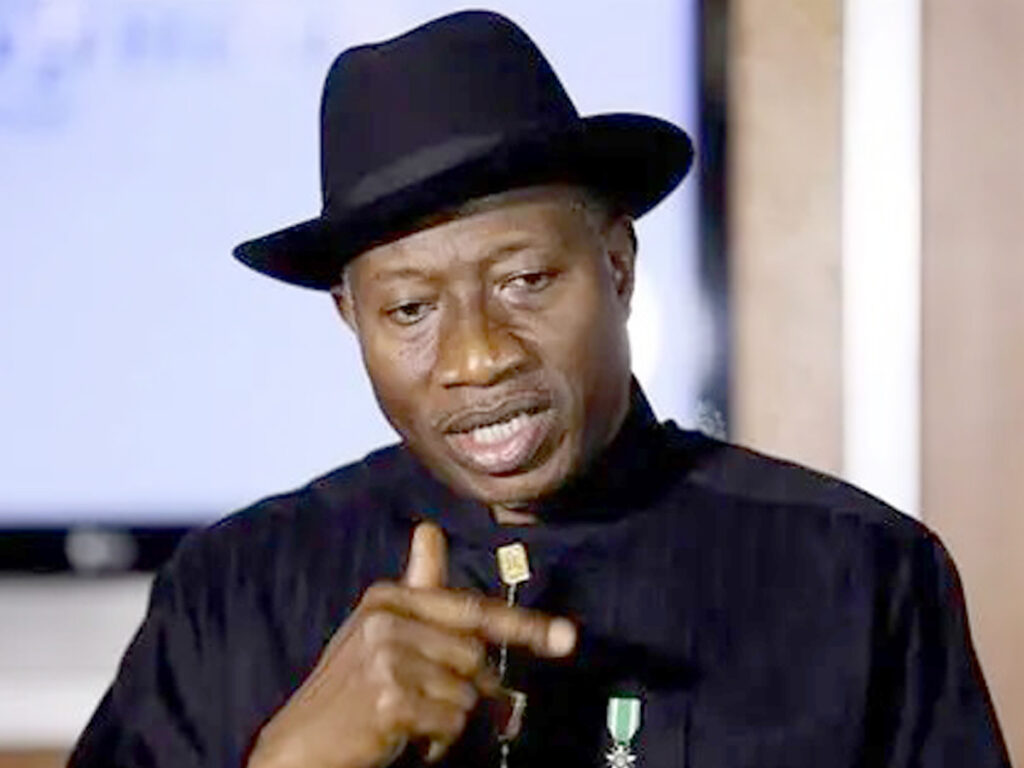

Former President Goodluck Jonathan has described the recent military intervention in Guinea-Bissau as more painful than losing to Muhammadu Buhari in the 2015 Nigerian presidential election.
Jonathan made the remarks in a video interview, reflecting on the unprecedented developments that unfolded while he was in the West African country as an election observer.
Jonathan was in Guinea-Bissau as part of the West African Elders Forum Election Observation Mission to monitor the presidential and parliamentary elections.
He recalled that, while official results were still being collated, the military reportedly seized power, leaving him and his team stranded and raising concerns for their safety.
“What happened in Guinea-Bissau is quite disturbing to me, a person who believes in democracy. In fact, I feel more pain than the day I called Buhari to congratulate him when I lost the election as a sitting president,” Jonathan said.
“I have been quite particular about Guinea-Bissau. As a sitting president then, Guinea-Bissau was in crisis. It started around 2012. In 2011, we had to go physically and work with them and made sure that the 2013 elections were conducted,” he added.
Jonathan described the incident as “bizarre” and said it did not fit the typical pattern of a military coup.
He questioned the credibility of the military’s claim, highlighting that President Umaro Embaló himself announced that he had been arrested while continuing to speak to international media.
“It is painful for me that President Embaló was the one announcing a military takeover of the government. It is totally unacceptable,” Jonathan said.
“For lack of a better word, I would say it was a ceremonial coup because it was President Embaló who announced the coup before the military later came up to address the world that they were in charge of government,” he further said.
Jonathan advised against engaging the military in an attempt to reclaim power and called on the Economic Community of West African States (ECOWAS) and the African Union (AU) to release the full election results.
He also demanded the release of opposition leader Fernando Dias, who was detained during the upheaval, insisting that he had not committed any offence.
Recounting his evacuation, Jonathan said he was airlifted by the Ivorian government. While both Nigeria and Côte d’Ivoire had arranged aircraft to bring him and his team home, the Ivorian authorities secured clearance first due to their proximity to Guinea-Bissau and traditional ties between francophone and lusophone countries.
Jonathan explained that the Ivorian plane was already en route when Nigeria received approval to deploy its aircraft, prompting his team to opt for the faster evacuation.
According to Jonathan, reports from ECOWAS, AU, and other observer missions indicated that the elections had been conducted peacefully and that results were being properly collated, suggesting the military intervention may have been premature or staged.
The former president expressed concern over the broader implications for democracy in West Africa, stressing that credible elections and the rule of law must be upheld.
“They cannot change those results. They should tally all those results and announce. They cannot force the military out. They must announce, let the world know who won that election. They owe the world that responsibility,” Jonathan said.
Jonathan returned safely to Nigeria on Thursday aboard an Ivorian aircraft, as documented in photographs shared upon his arrival.