
December 23, 2023
Two and a half years ago, just two days before Christmas, the rest of the world woke before I did. I woke to the Ibadan chilling harmattan wind surging through the open window I had forgotten to shut the night before. On an ordinary morning, I would have closed the window, burrowed deeper into my sheets and drifted back to sleep. But journalism, during festive seasons, is a thief — it steals time, comfort, and rest.
I dragged myself out of bed with a lazy yawn, my waking mind belatedly syncing with the day’s schedule: an NGO had invited me to cover their grand Christmas fanfare for underprivileged children in some parts of Ibadan. As my feet touched the cold tiled floor and I reached for my phone, my neighbour’s radio, a floor below my room, came alive with a Christmas song: “Mary’s Boy Child Jesus Christ, was born on Christmas Day…”
The song filled me with memories of home, of my childhood, of the town in Rivers State where I grew up. For someone who hadn’t visited home in seven years, I was still for a moment, reminiscing about the good times those Christmases brought — family gatherings and childhood friends long out of reach.
My neighbour’s radio floated another Christmas song I couldn’t name. It pulled me deeper into the revelries of my childhood during a season like this. But in recent years, my faith in the season had wobbled like an old man’s gait, its essence dimming like a firework fading on a Christmas Eve.
The time on my phone said 7 a.m. At the same time, an SMS was staring at me. It was a kind reminder from the founder of the NGO enquiring if I could still make it to the event. I could have replied with a No and slipped back into bed, but that would have been a disservice to her, given our enduring professional relationship. And, besides, with Christmas swelling in the air, I owed it to the children — the children who, unlike me, had no home to return to, no bed to crawl back into, perhaps nothing to eat that day, and little chance of experiencing Christmas the way I did as a child.
…
On my way to the first venue of the fanfare at the Mokola Roundabout — under the flyover that was constructed to ease traffic, but now served as a hub for petty traders, a lair for hoodlums, and a home for the homeless — I sat in a taxi thinking about how the day would go. Working with NGOs was something I would avoid if I had the choice, which I didn’t, thanks to my job. Time, especially during these festive seasons, was something I needed most to reflect on how I had lived my life — the successes and failures, the wins and losses, the excitements and disappointments, the mistakes and lessons learned, the—
The husky voice of the driver announcing the final destination of our journey brought me back to reality. I alighted from the taxi and took a deep breath to ease the tension in my gut, building up from the possibility of a stressful day ahead covering the events in two different places: Mokola and Sabo neighbourhoods.
The NGO and its beneficiaries, mostly children and women of Hausa/Fulani origin, were already there when I arrived. At first, the scene brought the imagery of Chinua Achebe’s poems, A Mother in Refugee Camp and Christmas in Biafra (1969), to my mind, where he respectively reflected on the relationship between a poor woman and her child, and on Christmas during the horrors of war.
At the two different venues, amid the noise and rush hour, in the lure of shiny lights and decorations, and in the heights of shopping and travelling, it was easy to forget the sick, the poor, the needy, and the homeless. I looked around and noticed that we were all culprits in this, that we seldom cared, that we were inconsiderate, even in this season of love.
These were people I usually passed on my way to work without giving them a thought, but here I was surrounded by them, appreciating their humanness, and amazed at how much we had in common.
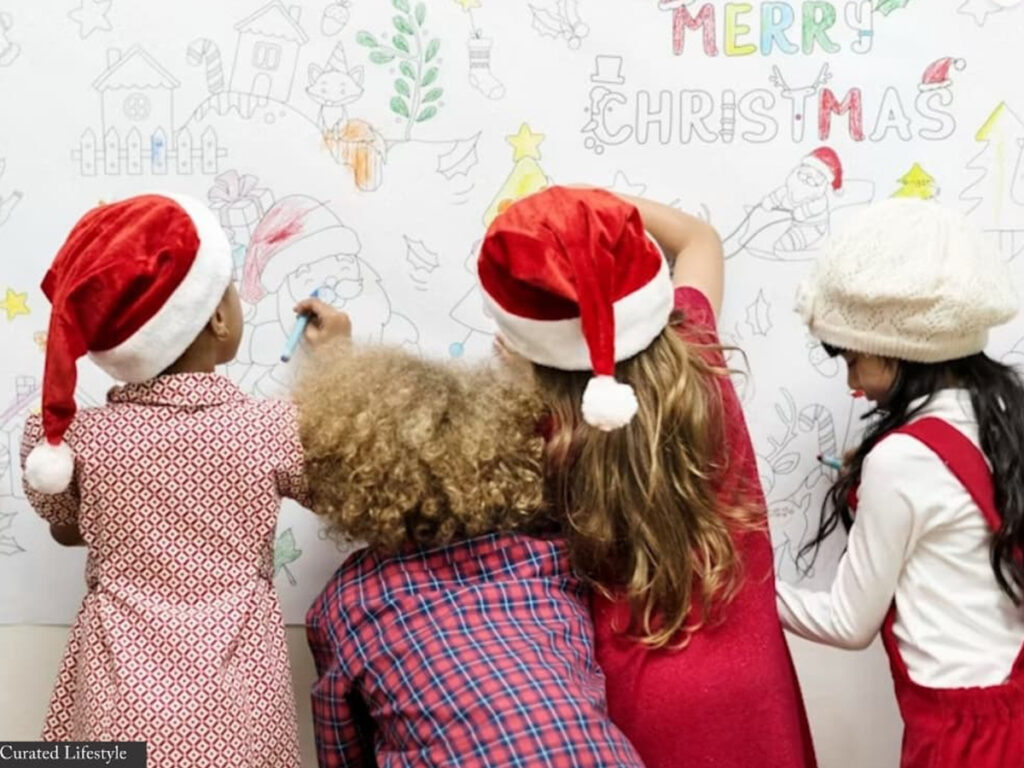
All was set. Music was bellowing from the speakers on the makeshift stage. One by one, as the music filled the air and as Father Christmas doubled on his clownish dance, more children arrived. I watched as food, drinks, and gifts passed from one hand to another, from one heart to another. It was like they could taste the joy in their souls on their lips as they savoured the food and drinks. I noticed how merely being alive today was enough for them, how the realities of lack dissolved in those brief moments. I saw no fear or shame. It was as if they had forgotten all their individual and collective paucity.
Here was a people, a community, benefitting from a woman they didn’t know, a woman who had a choice like everyone else — to leave these people holding wind in their hands or holding love in their hearts. From the warmth and colour in their eyes, I was sure this simple miracle would resonate in their hearts for a long time. The smiles and gratitude on their faces reminded me that there was some good and hope in this life, even when the world seemed not to care.
…
December 25, 2023
It was Christmas Day, and I didn’t know how I felt about it. The morning was cold, even with the rising sun in the sky. The entire neighbourhood was so quiet as if it were recovering from the aftermath of a war. My neighbours who didn’t travel had already set the day in motion with food preparation whose aroma was mesmerising my nose. I stood outside my apartment, taking in the cold, the sun, the aroma, and everything the morning had to offer.
A Christmas song, ‘Santa Claus is Coming to Town’, was playing from my neighbour’s apartment, and one of her children was singing along. I used to do that as a child, but here I stood, indifferent to the tune and the significance of the songs, of what today was. I could only relate to today in memory, the good old days of my childhood — that special feeling of being dressed up in new clothes and shoes, basking in the smell that came with their newness, feeling anew in body and soul, and ready to visit distant relatives where food and drinks were certain. I could remember my siblings and me in photographs wearing clothes made from the same materials, flashing teeth that had relished the chickens our father had bought and the special pepper soup, stew, and rice our mother had prepared. I could also remember the frolics, the masquerades, and the fireworks.
In those days, there was something special about Christmas. It was a day you could do all you wanted, eat all you wanted, and be all you wanted. It was like the vibe covered all transgressions and pardoned many sins. The love spread from heart to heart, home to home, like the conspicuous harmattan wind the day was known for.
Standing outside my apartment, feeling the wind as the sun warmed my body, I searched for the vibe and love of my childhood Christmas days and could seldom find them. These formative recollections made me wish I were still a child, devoid of doubts and fears, free from ceaseless pressure and responsibilities, and unburdened with the daily demands of life and adulthood.
For many years, I hadn’t attended Christmas Day church service, and I didn’t intend to attend one today. But my mother had called early, waking me from sleep, to wish me a merry Christmas and ask if I had cooked something special today. I didn’t. It didn’t even cross my mind to. But I told her I did to prevent a sermon that would linger. She had paused for a fleeting moment and repeated the same question. I repeated the same answer. Another short silence ensued, then she asked if I would go to church today. I thought about it, of all the best ways to say no without disappointing her, and ended up saying yes. I was in a dilemma — go to church or not go. I really didn’t want to go, but since I had promised her that I would, I decided to, if not for anything, to atone for the lie.
…
On this Christmas Day, All Souls Church, Old Bodija, Ibadan, looked different. What caught my attention were the decorations at the entrance depicting a scene of Christ’s birthplace. I smiled at Madonna and Child, at the three wise men, and walked into the church.
I sat on one of the back pews. After a procession of singing and dancing, the priest preached on the prophecies that heralded the birth of Christ and the love of God for mankind that made Him send His Son to earth. He said that most people who didn’t have good relationships with their parents, especially their fathers, found it difficult to trust and believe in God.
I pondered his words. I looked around — not only in the church but also in my mind, far into the city and beyond — and wondered about the staggering number of people in the world without fathers or who didn’t have good relationships with their fathers. My thoughts drifted to the street children at Mokola and Sabo. And then it struck me: while we — the relatively comfortable people in church, dressed well, smiling easily, with special meals waiting for us at home — needed God’s love, those children needed it more, along with the small mercies and borrowed abundance that Christmas promised, and beyond.
The priest continued preaching. Yet I sensed something else moving with the harmattan wind amid the celebration. From time to time, I glanced out the window, wondering if the rest of the congregation could feel it, too: the wind, and the quiet mysteries it carried. Beyond the carols, could they sense the subtle indifference of the world, the brevity of the day? Was this how Christ would have wanted it?
Another priest, while anchoring the praise and worship session, said that one thing about Christ was this: when you celebrate Him, He is still the One who gives you gifts.
I reflected on what the priest meant. It revealed to me the simple truth: that all humans, irrespective of status or belief, are vulnerable to desire — for things tangible and intangible, which is legitimate, both for those who have nothing and those who have everything.
When the church began to pray for Christmas gifts from Christ, a woman to my left spoke in tongues, her body trembling. The atmosphere grew charged. Voices rose everywhere, as though we were in a competition for the best gift, as if after today Christ would close the heavens to giving until the next Christmas.
I didn’t know what to ask of Christ, not because I was perfect or already possessed all the world could offer, but because I liked my life and the day, just as they were. I chose the wind and the dust it carried. I chose our shared presence, the warmth of our collective energy. I preferred the world we created in that small space, without demanding anything from it. I chose a Christmas that placed no demands on the world or on Christ, because the simple fact that He came to show us the way towards all that are good and noble felt, to me, like enough.
…
On my way to Dugbe in a taxi, I felt the evening harmattan wind more. On the other hand, the momentum of the day and the revelry that came with it were waning like the setting sun in the clear sky. The scenery reminded me of my childhood Christmas memories, and comparing these memories with what contemporary Ibadan had to offer made me feel as if I were experiencing time travel.
Christmas evenings in my childhood days were bustling. Virtually every young person was outdoor. Fireworks and knockouts cracking. People chasing masquerades and masquerades chasing them. The beehives of these activities were usually around public spaces — football fields, public schools, and marketplaces. Fancy places, like fast food restaurants, cinemas, game houses, shopping malls, and exotic clubs that now dotted the contemporary Ibadan landscape weren’t there then in the Rivers State town I grew up in. The masquerades and their drummers, the barbeques and ice creams wrapped in transparent nylons, our innocuous swaggers in our new clothes and shoes, were all we could boast of, all we needed to make the day count.
I threw myself and my thoughts back to reality. The sun had almost concealed itself in the sky, the breeze was getting colder, and I was now standing in front of one of the tallest buildings in Ibadan, standing too close that its imposing height and size couldn’t allow me to see the sky above it. There was music from multiple sources. There was laughter and chatting. There was an aroma of not just food and perfume, but also of life and affluence.
This tall Cocoa House was located in Dugbe, a popular section of the city that I usually passed on my way to work. Today, however, it looked different, like a place brought in from a foreign land. The aura it commanded today betrayed its usual disposition, and this betrayal was something I found refreshing. My wristwatch said it was some minutes to five o’clock, and I was getting impatient to explore what the building had for us today.
The environs of the Cocoa House housed the Cocoa Mall and the Heritage Mall, and I was standing at the entrance of the Cocoa Mall that I had lost count of the number of times I had patronised its stores. Strangely, today, I neither had any store in mind to patronise nor anything to purchase. I was only there as the spirit led — perhaps, to escape the boredom of being at home, buried in work. Whatever it was, I was glad I was there, immersed in a pool of people and music.
At the entrance of Cocoa Mall, people were milling about, mostly children in beautiful clothes. There were also a few in grubby clothes, begging for alms. Looking at the lowly children as I stepped into the mall, I wished I had millions of naira on me to buy them nice clothes, shoes, toys, and game tickets for them to feel at home like their rich peers, but I only had N3000 on me.
Inside the mall, this class dichotomy was pronounced at the game section, where children of rich parents were playing virtual reality (VR) video games, riding children’s cars, and doing other paid fun stuff, while a few children of little or no means watched from the corner.
Filmhouse Cinema in Heritage Mall, just a few minutes away from Cocoa Mall, was filled to the brim. The lights were so bright, the sounds so high, the camaraderie so loud. It was as if everybody in Ibadan was there. But, unfortunately, all the money I had on me couldn’t buy me a movie ticket.
After a few moments of immersing myself in the lights and sounds, among a pool of happy people, and the aroma of snacks and drinks, I walked out of the cinema to the game section to watch a snooker game. I watched a couple of people play, including some children trying out the game, probably for the first time. It reminded me of my secondary school days, when we would sneak out to learn the game in the house of one of our classmates whose elder brother ran the game as a business. That was a long time ago, and virtually everything that I learnt about the game back then had gone with those years.
I wanted to feel what it felt like to hold the smooth stick and pot some balls. So, I paid for a session. My opponent was seemingly a professional who gave me a run for my money. When he was left with one ball to pot, I was struggling with four. Unfortunately for him, he mistakenly potted the black ball, automatically making me the winner. It was a miracle — a rookie winning a pro. However, I was unfortunate during my second leg of the game because I was beaten by another player. And, since it was getting late, without much money on me to continue the game, I called it a day.
As I was stepping out of the mall, I met two teenage boys in grubby clothes begging for money. As I walked past them, I hoped they would find some happiness and merriment today.
…
In a taxi, on my way home, even though I wasn’t sure home should have me yet, the sun was nowhere in the vast sky. In my childhood days, by this time, my siblings and I were either home or on our way home from our yuletide jamborees, with our clothes and shoes covered with dust and stains, and our stomachs filled with food and drink to the point that a deep night’s sleep was inevitable. But before sleep came, we would rehash our day. We would satiate our mother — who usually didn’t accompany us to our outings, unless we followed her to visit her friends or family members — with tales of our exploits and frolics. And, of course, we wouldn’t tell her the exact amount of money we were gifted, for if it was much, she would collect the bulk of it, with the excuse that it cost her a fortune to purchase the clothes and shoes we flaunted.
It was a smooth taxi ride, smooth like the cold breeze chilling my face, pacifying my lungs, and mesmerising my soul. I needed more of that, not just from the breeze, but also from something I was yet to place, which was nudging me from within, demanding expression. Then, I sniggered to myself. You know that awkward feeling when you’re inundated with thoughts of doing something, and doing it or not wasn’t bad.
The taxi banked around a corner, throttling down on a gently sloping road towards Awolowo Avenue on Old Bodija, one of the oldest estates in Nigeria, dotted with hotels and nightclubs, and pricy restaurants and malls. This was one of the roads I plied to work. But today, it looked different in mood — inviting, tempting. It was the busiest, liveliest, and noisiest road I had plied today — this avenue full of old buildings that had refused to grow old and a few new ones that housed mostly businesses rather than homes.
Amid the noise, the feeling nudging at me was still there, growing in intensity. A few minutes later, it finally dawned on me. I smiled with a subtle sigh. It was something that I hadn’t done in months, perhaps throughout the year. The thought of it was unbearable now that I could picture its white foams, its chill on my eager tongue.
So, as the taxi approached the end of the avenue where it formed a T-junction opposite the United Bank for Africa (UBA), I told the driver I would be alighting.
Home could wait for another one or two hours.
…
The night was gradually blanketing the city when I alighted in front of Plat’num Club on Awolowo Avenue. The multi-coloured lightning was blinding, and the music was deafening. The DJ was trying and failing to make the songs sound like his own, like a live band. Cars were packed everywhere, causing traffic. People were milling around. There were scarcely dressed ladies hanging out at corners where light couldn’t reach, waving, smiling, and beckoning to men.
In my seven years of residency in Ibadan, this was the first time I was patronising a nightclub. I initially had mixed feelings about this. But it was Christmas. The merry must go around. After a quick survey of the bustling club, I stepped in, and it felt as if I were in a different city, a city of light and sound. Bottles filled tables. People were chatting and laughing over loud music. Dancers were shaking their bodies to the rhythms of the songs.
I took in the scenery with awe and caution. Most of the seats were occupied. Closer to one of the bars, I spotted a lone table with three seats around it. I sat on one of the seats, taking in everything. A few minutes later, after briefly watching the highlights of a football match I wasn’t enjoying, because I wasn’t a fan of football, I ordered a bottle of Heineken beer with the last money on me, probably my second or third beer of the year.
My father was a Heineken lover, and there was usually this special calmness around him whenever he was drinking it. If the world were on fire in that moment, he wouldn’t notice. As I sipped the beer the way my father would, I was sure he had taken some bottles of the beer today, as he used to when I was a child. I wished I were at home to share some bottles with him, to toast to life, to today, to everything.
After some moments, WizKid’s Ojuelegba filled the air, with some people singing along. I listened, slowly nodding my head. I looked around and was happy everyone was “feeling good tonight…” Irrespective of our faiths and fates, we were all here “thanking God for life…” And, in the face of our challenges, “Oh, I can’t explain” the joy in our hearts.
If only WizKid could see us now.
My beer was now almost finished. It was getting darker, but the club was only warming up, with more people trooping in, and the waitresses serving drinks at the speed of light. I sipped the last contents of my beer and left the club.
Outside, the sky was moonless and starless, with no allegiance to the people far below it. The traffic was terrible, and some of the scarcely dressed ladies were having a field day with men.
As I was about to cross to the other side of the road, to begin my twenty-minute walk home, one of the ladies ambled past me, smiled, and said, “Merry Christmas.”
I smiled back and mumbled, “Same to you.”
…
On my way back home on foot, cars zoomed past me, and the wind hugged me from all sides. As I thought of how my day had gone, words failed me. I looked around, and it seemed like I was the only person on the road, as if I were the only person in the world. Perhaps that was how the day had been for me.
But the day had its own moments of reckoning. As I got closer to home, the breeze seemed to have changed momentum and tone, whispering things in my ears, stirring up things in my head. Then the images and memories came, and I allowed them to wash over me like the breeze, like a tide nudging a boat.
The smiles of the less privileged Mokola and Sabo people filled my vision as if I were reviewing them through a big-screen television. I wondered how a season like this could unabashedly mirror the staggering gap between the poor and the rich. Growing up, I didn’t realise the sacrifice my parents made and the pain they went through to put food on our table, a roof over our heads — and, in the spirit of seasons like this, to ensure we always had a merry Christmas.
It reminded me of a Forbes Africa interview about Indian philanthropist Shobhana Wahi and one of the letters Nobel Laureate Mother Teresa sent her for supporting the poor in India. In one of the letters, Mother Teresa had admonished Wahi to “Keep the joy of loving through sharing. God’s ways are so wonderful. He keeps using the poor to be His sunshine of love and compassion in the world by drawing us all together.”
I realised we couldn’t all be Shobhana Wahi or Mother Teresa, but I was glad I was at those events and witnessed how God used his love and compassion to draw us all together.
I could hear the voices of the priests and the congregation praying for the best gifts from Christ. I felt the energy in their voices, the agency in their demands. I could hear them as clearly as the Christmas songs from my neighbour’s radio this morning. If I were Christ, especially in the spirit of today, I would give them all they asked for and more.
I thought of the lowly children at the malls and remembered that we were told that Christ was born poor, and in a poor place. On the other hand, I saw in the eyes of those children the burning desire to live above their present conditions, to celebrate Christmas like their rich peers. These desires were valid, and I hoped the validity of the desires and the benevolence of the world would make future Christmases worthwhile for them.
Scenes from the club returned. I could still taste the beer on my lips. I could still hear WizKid telling us his story through Ojuelegba. I smiled at the people dancing and shouting to the rhythm of the songs. Then I recalled the beautiful smile of one of the scarcely dressed ladies as she wished me a merry Christmas.
I chuckled at all that Christmas could make us do.
I imagined how today would have been in the nineties — my mother shopping for the right clothes that would fit us well, cooking special meals we might not eat again in a long while, and my father doing all he could to make the day count for us, and the people in the scary masquerades that chased us around. They were all old now, but still young and much alive in the wind nudging me home.
And here I was alone in the cold night, amid bright lights twinkling on the restaurants, malls, and banks I passed, asking myself: Did we invent Christmas to celebrate Christ or to satisfy our unspoken tendencies for consumption and superiority?
Whichever it was, it was all good. We were all Christmas children, always anticipating the next Christmas, and the next, and the next, even when we didn’t know why. ♦
Kingsley Alumona is a geologist, writer, poet, journalist, columnist, and media consultant. He holds a BSc in Geology from the University of Nigeria and an MSc in Geophysics from the University of Ibadan. He is a senior reporter with the Nigerian Tribune newspaper, the managing editor of Naira Stories Magazine, the founder of Naira Publishers, and also the founder of Naira Entertainment Group. He is an alumnus of the 2024 Nigerian Academy of Letters’ Creative Writing Workshop. His writings have appeared in the 2018 African Book Club Anthology, Kalahari Review, Nthanda Review, TUCK Magazine, Brittle Paper, Afritondo, Digirature, Ngiga Review, Pawners Paper, Omenana (Issue 17), Transition Magazine (Issue 131), Afrocritik, Botsotso Literary Journal, Fortunate Traveller, Farafina Blog, 2026 Naira Books short story anthology A House That’s Not a Home. You can reach him on Facebook: @kingsley.alumona.1.