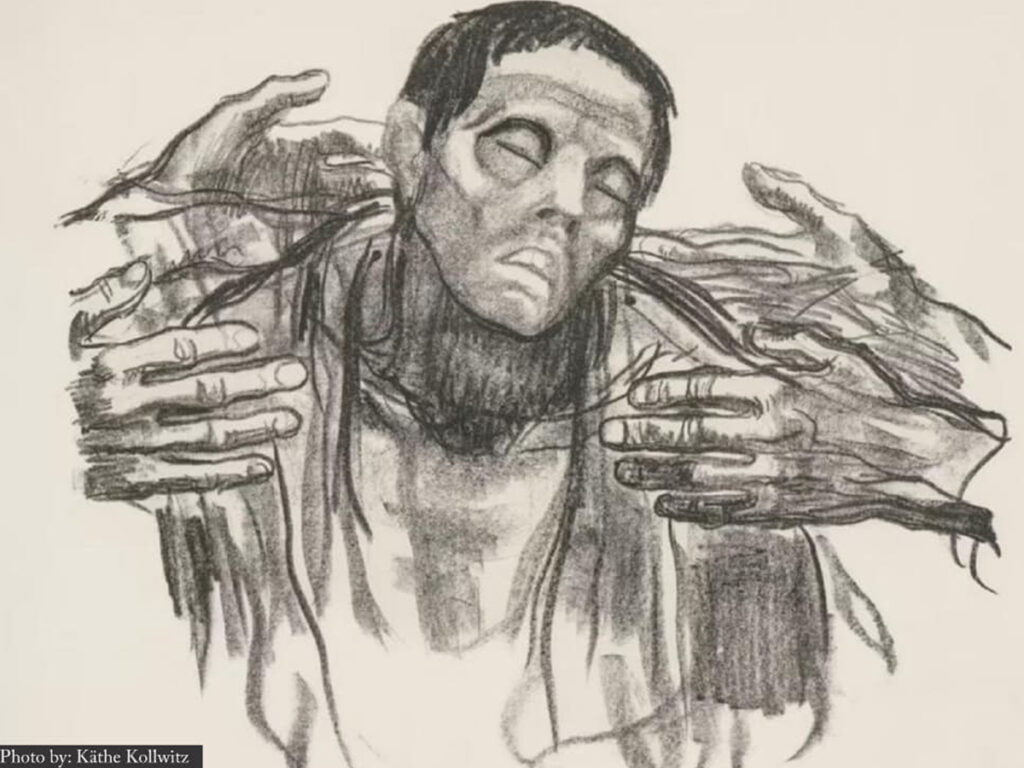

The first time I encountered what people call possession, I was sitting outside my friend Ridwan’s house at dusk, waiting for the call to Maghrib prayers. The house was a two-storey building, the kind where landlords divide a single structure into two separate flats to maximise rent. Ridwan and his family lived upstairs. The neighbours lived below. The only access to the upper flat was through the neighbours’ sitting room, where a staircase rose along the back wall. Privacy was theoretical. To visit Ridwan meant knocking on the neighbours’ door, removing your shoes alongside theirs, stepping past their lives to reach the stairs.
Then, like bolts of lightning, the neighbour’s siblings ran out of the house, barefoot, crying out, speaking over one another. They said their sister was rolling on the floor. Possessed. Their mother wasn’t home.
Outside the ground-floor door, slippers and flip-flops were scattered across the entrance like evidence of flight. From inside came the sound of breaking plates — sharp, irregular — followed by voices trying to sound calm but failing.
Ridwan and I knew the verses Muslim clerics recite in moments like this. But we didn’t go inside to help. Knowing words isn’t the same as knowing when to use them. Someone else was called.
…
While we waited, people began to gather. Two hefty men had gone inside to hold her down. Ridwan and I went to the nearby mosque to pray. I kept my eyes closed and my forehead pressed to the ground, but I couldn’t stop thinking: how does a fourteen-year-old girl come to this? Between rakat, I whispered the adhkar for protection: A’udhu bi kalimatillahi at-tammati min sharri ma khalaq. I seek refuge in the perfect words of Allah from the evil of what He has created.
By the time Ustaz Ibrahim arrived, the cleric who had been called, the girl’s parents had returned. Night had settled over the whole house.
Ustaz Ibrahim, a married man, was a very tall man with a goatee, wearing a brown kaftan with spiral designs embroidered along the sleeves. He had been my teacher in Quran memorisation: stern, disciplined, unshakable. Before entering, he paused at the entrance and recited Bismillah, in the name of Allah, then stepped inside.
I stood in the doorway. The two men were still holding the girl. I could see her struggling against their grip, her body twisting with a strength that seemed impossible. When she saw Ustaz Ibrahim, her face changed. She tried to break free, but the men were too strong.
Then she bit her tongue.
It wasn’t sudden. It happened slowly, deliberately, as if she had made a calculation and arrived at this solution. Ustaz Ibrahim had begun reciting Qul huwa Allahu ahad, Allahu samad, and she couldn’t move her arms or legs. So she found the only part of herself she could still control, and her jaw clamped down with a wet, grinding noise that I heard before I saw the blood. It came quickly, filling her mouth and spilling over her lips, dark and thick, running down her chin and onto the front of her dress. One of the men screamed while the other tried to pry her mouth open, but her jaw was locked. Someone ran for water, as someone else began to cry.
The blood pooled on the floor. It spread slowly, a widening circle no one could stop.
…
Ridwan called me the next day.
“She died,” he said.
His voice was flat, factual, as if he had been saying it to himself all morning to make it feel real.
After Ustaz Ibrahim left, they called a nurse to check her. The nurse gave her drugs: painkillers, Bromazepam — as Ridwan told me — and instructed them to watch her through the night. At around 3 a.m., they said the girl woke up and told her parents she couldn’t feel her mouth. Then her hands went numb. By dawn, she was gone.
No one asked about the drugs. No autopsy. Her family wouldn’t have thought to request it. The drugs, the tongue, the recitation, the jinn (in Islam, jinns are invisible creatures, neither good nor bad, believed to influence people and places, according to the thoughts and beliefs of man): all of it folded into her death without separation, without answers.
Later, an explanation quietly moved through the neighbourhood without argument or spectacle, but no one could say whether it was the ruqyah that killed her or the jinn or the drugs. So, they settled on everything or nothing, or simply that these things happen.
Years later, I would lie awake thinking about her and what happened in that room between the recitation and her death, whether the jinn fought to stay or whether her body simply couldn’t survive the violence of the encounter, or whether it was never a jinn at all, but just a girl having a seizure while we all stood by interpreting her suffering through a spiritual lens when she needed medical intervention.
But, that night, walking home from Ridwan’s house, I only knew one thing — I had watched someone bite her tongue for a reason I don’t understand.
…
The second time I encountered what people call affliction, it came neither suddenly nor dramatically. There was no possession, no rolling on the floor, only my brother falling ill at university with aches spreading through his stomach, back, and hands. Every test for HIV and malaria came back negative, except for the peptic ulcer. I guess that explained the stomach pain. The pain in his hands, his back, the aches that moved through his body like something searching, these remained unexplained.
Later, he moved to the Czech Republic, where he sought better treatment with his wealth through multiple gastroenterologists, psychiatrists, and countless tests. The doctors said the ulcers had healed. The tests now showed nothing. He was well, they said. As well as anyone.
But he wakes from dreams in which he has been fed. Women he doesn’t know offer plates of jollof rice and pounded yam, dishes that dissolve from memory when he wakes. Strange figures present food he doesn’t remember accepting. Dreams where birds fly against the grammar of the sky, where a woman, oddly dressed, appears and disappears before he can focus. Severe pains follow the waking, as though something inside him has accepted a gift his body didn’t ask for.
When I told my Islamic teacher about these dreams, he asked specific questions about whether they recurred, whether they left physical traces, whether my brother felt watched even while awake, and when I answered yes to each one, he nodded slowly.
“The Prophet Mohammad taught us that dreams come from three sources,” he said. “From Allah, from the self, or from Shaytan (the devil). Most dreams are from the self: your own thoughts, your anxieties. These fade with morning and leave no mark. But dreams that recur, that bring pain upon waking, that feel like violations rather than reflections, these are different.”
A psychologist would disagree. They would say the pain is psychosomatic, that belief in jinn creates the very symptoms we attribute to them. Perhaps that’s partially true, since belief shapes experience in ways we don’t fully understand. But it doesn’t explain why my brother, stable and successful, and not given to hysteria, wakes to pain that no doctor in two countries could diagnose yet responds, however temporarily, to verses from the Quran.
I didn’t understand the patterns then. I thought these were separate events — my brother’s illness and the girl who bit her tongue — unconnected except by proximity. It would take years, and my own affliction, before I began to see what these all shared.
…
Around October 2023, I began having intrusive urges to end my life, unable to look towards the balcony to my left or the street below or certain corners of my room without negative thoughts flooding in. As though the air itself carried instructions to accomplish this purpose.
At first, I thought it was malaria. Indeed, I had a fever at the time.
I was admitted to the hospital in the evening, my first hospital admission. The hospital was on the next street, close enough to walk if I had been stronger. It smelled like antiseptic and floor wax, the kind of smell that tries to cover something older and more persistent underneath. The light bulb was solar-powered, humming faintly in the hallway. Outside, crickets filled the night with their small, repetitive song.
My room had two beds. The other patient was a man who had been bitten by a dog. He lay on his side, facing the wall, his bandaged leg elevated on a pillow. He didn’t speak. Neither did I.
I didn’t know my mother would stay. I thought she would go home after the nurses finished their rounds. But when I woke around 4 a.m., she was there.
NEPA had just restored power, and the alarm’s sudden buzz pulled me from sleep. The fluorescent bulb above my bed flickered twice before it steadied.
I saw my mother lying on the floor beside my bed, on her right side, the position Islam describes as the best for sleeping. She wore a full jilbab, dark blue, and had fallen asleep on her prayer mat. In her hand, she still held her prayer beads, thirty-three wooden beads on a string, her fingers loose around them as if she had been counting them and then simply stopped.
I wanted to cry, not from the pain in my body or the thoughts in my head, but from knowing I didn’t want to put anyone through this, especially not her. I looked at her folded into the tiles, her breathing slow and even, and thought of how she had already watched my brother battle something that wouldn’t leave him despite every treatment, every test. And now, here was another son. Now, here I was, possibly afflicted with the same thing, and she was sleeping on a hospital floor because she wouldn’t leave me alone.
I prayed quietly, my lips moving without sound. Ya Allah, if this is something that can go away, take it from me. And if it’s not, give me the fortitude to bear it in this life, because I can only bear such pain here, not in the hereafter.
After some time, she woke up. She saw me sitting up, reciting Surah Al-Haqqah, one of the surahs I had memorised as a child. The words came easily, even when nothing else did.
“Did you just wake up?” she asked.
“Yes,” I answered.
“Alhamdulillah.” She sat up slowly, folding the prayer mat. “Do you feel better than when we came?”
“Yes,” I said.
It wasn’t entirely true, but it was true enough.
…
After treatment, the fever broke, and I was discharged. However, the intrusive thoughts remained. So, my Islamic teacher gave me things to drink and taught me supplications. He showed me how to prepare holy water by reciting certain verses on it, then spraying it on my bed before sleeping. We sat in his study as he explained these things, a small room lined with books, the afternoon light coming through the window in strips.
“The jinns who afflict have made terrible choices,” he said. “But they aren’t terrible by nature. They became what they are through sustained bad choices.”
He paused, pouring water into a cup.
“People will assume your affliction means you have sinned. They will whisper. But the Prophet himself sought protection from the evil eye. Even the most righteous are vulnerable,” he added.
I carried those words with me when I left his study. I had just learned how to sleep again, as one might relearn a forgotten skill. Every night before sleeping, I followed his instructions without fail.
…
I understand the scepticism this invites. It’s the kind of scepticism I might have had myself, in a different life, in a different body. If the evil eye were real, the objection goes, then everyone who is admired or envied would be afflicted, and we would all be victims of each other’s wanting. Western psychologists often explain belief in the evil eye as a submission to rumours without testing their validity, or as a manifestation of self-destructive tendencies and pessimistic thinking, the mind creating the very traps it fears.
But this isn’t merely religious superstition, not something whispered by grandmothers to keep children humble. The Prophet Muhammad said, “The influence of an evil eye is a fact; if anything would precede the destiny, it would be the influence of an evil eye.” This is a sahih hadith (authenticated narration) from the most reliable Islamic sources, the kind of text scholars have examined for fourteen centuries. The concept appears explicitly in the Quran itself, in Surah Al-Falaq (113:5), where believers are instructed to seek refuge “from the evil of an envier when he envies.”
There is also a famous incident recorded in the hadith collections, one that has always stayed with me for its strange immediacy: Sahl ibn Hunayf was bathing when a companion saw him and exclaimed, “I have never seen anything like what I have seen today, not even the skin of a virgin.” The words were barely spoken when Sahl fell ill on the spot, his condition worsening as though the admiration itself had weight, had consequence.
When the Prophet was informed, he said, “Why does one of you kill his brother? Why did you not say, ‘May Allah bless you?’” The harm was immediate and witnessed, not metaphorical but physical, and the remedy was specific: the person who gave the evil eye was asked to perform ritual washing, and the water was used to cure the afflicted, as though envy could be washed away like any other stain.
This isn’t about every glance or every envious thought turning into harm. Islamic teachings are more precise than that, more technical. The evil eye occurs through repeated looking combined with envy, particularly when the admirer fails to invoke Allah’s blessing — fails to say “MashaAllah” (God has willed it) or “BarakAllahu” (May Allah bless you).
My brother wasn’t simply unlucky; he wasn’t just another person who fell ill for reasons medicine couldn’t name. His symptoms fit the pattern described in Islamic texts and recognised across cultures — pain that migrates without medical cause, health problems that persist despite exhaustive treatment, and afflictions that respond temporarily to Quranic recitation but not to medicine.
Dreams of being fed by unknown women, waking pains that follow no medical logic, years of tests in two countries — Nigeria and the Czech Republic — showing nothing wrong, as though his body had become a locked room and all the doctors were knocking on the wrong door.
Is this proof? No. I can’t prove the evil eye exists any more than I can prove jinn exist, any more than I can prove that the neighbour’s girl died from anything other than fear, drugs, and bad timing. I know the counterargument: that belief itself creates these patterns, that we see what our faith trains us to see. Perhaps. But belief alone can’t explain why treatment that should work, that my brother faithfully pursued in two countries, provides no relief, while verses recited on water do.
But when the Prophet Muhammad himself sought refuge from the evil eye and commanded his companions to use ruqyah for its cure, when he validated this experience for his followers fourteen centuries ago, I can’t dismiss it as mere superstition. The alternative, that my brother’s wealth, his visibility, his success opened him to harm through the envy of others, is what my faith teaches.
Whether this operates through spiritual forces, psychological mechanisms, or something science hasn’t yet named, I don’t claim to know. I’m not a scholar, not a scientist, not someone with answers. I know only that the pattern exists, that my brother’s affliction followed his success the way thunder follows lightning. And that Islamic tradition, dating back 1,400 years, has always taught us to seek protection from the harm of the envier, not because we’re paranoid, but because we have seen what envy can do when left unchecked, unblessed, unacknowledged.
…
I could tell you more about the evil eye, cite research, quote hadith, and build a complete argument. But that would be avoiding what needs to be said: knowledge is one thing, and watching your brother cry on a sofa while your mother pours water over his head is another thing entirely.
It was a Friday afternoon when I came home from Jumu’ah and found him on the three-seater, curtains drawn, light leaking through the edges in thin lines across the floor. My mother knelt beside him with a cup of water, making supplications as it ran down his face and soaked into the cushions. He cried silently, the kind of crying where tears come without sound, as if even his body knows there is no point in making noise.
“As-salamu alaykum,” I said from the doorway.
My mother looked up. “Wa alaykumu salam. Shigo, your brother is in pain.”
I stepped closer. “What kind of pain?”
“Everything,” she said. “Stomach, back, head. Like someone is burning his body from the inside. We’re waiting for Uncle Fahad to come and take us to the hospital.”
My brother didn’t open his eyes. His hands were pressed against his abdomen, his fingers curled tight. His breathing was shallow and uneven, the way people breathe when they are trying not to scream. I stood there. My mother continued pouring water, reciting Ayat al-Kursi under her breath, her voice steady even though her hands were shaking.
The pain lasted for 10 minutes. I watched the clock on the wall move in small, mechanical ticks, each minute indistinguishable from the last. My brother didn’t speak. Neither did I. My mother prayed and poured water and sometimes whispered, “It’ll pass. It’ll pass,” though I didn’t know if she believed it.
Finally, my uncle arrived in his car. They helped my brother to stand — he could barely walk, and took him to the hospital.
When they came back, the doctors had given him drugs: painkillers, anti-inflammatories, things with long chemical names that did nothing to explain what was happening. Later, my mother brought him black seed oil, honey mixed with Quranic verses written on saffron and dissolved in water, the old remedies people turn to when the new ones fail.
That day is something I can never rub from my mind, no matter how hard I try. Watching him that afternoon, I understood something I hadn’t understood when the neighbour girl died: affliction doesn’t announce itself and then leave. It moves into your life and makes itself comfortable. It becomes part of the daily routine, like prayer or meals. You learn to carry it.
…
Three weeks after I was discharged, I was writing at my desk when the thought came again. It was 9 p.m. I had been working on a circuit design for a client, running calculations for voltage drop across a resistor network. The numbers required concentration. I was deep in the work, the kind of focus where hours pass without notice.
Then: You should end it now.
The thought arrived fully formed, as if someone had spoken it directly into my ear. I stopped typing. My hands hovered over the keyboard.
Jump from the balcony.
I looked at the balcony door. It was closed. The curtain was drawn. But I could see it in my mind — the railing, the drop, the concrete below.
I stood up and walked to the bathroom. I had learned that movement sometimes helped break the thought’s grip. I turned on the tap and splashed water on my face, the way my Islamic teacher had instructed. I recited Ayat al-Kursi three times. The words came automatically after months of repetition.
I looked at myself in the mirror. My face looked ordinary, revealing nothing of what was happening inside my head. I thought about my mother finding me. I thought about my brother, already carrying his own affliction.
“No,” I said out loud. My voice sounded strange in the empty bathroom.
I mopped my face and went back to my desk. The circuit design was still there on my screen, the numbers waiting. I sat down and continued the calculation, as if nothing had happened.
This is what the Prophet Muhammad meant when he said: “The deeds most loved by Allah are those done regularly, even if they are small.”
Chronic affliction requires chronic resistance. Not dramatic exorcisms that resolve in a night, but daily practice, sustained faith, small acts of protection repeated until they become as natural as breathing. Returning to the work because the alternative is giving the thought what it wants: your attention, the belief that it speaks truth.
I finished the design around midnight. I said my prayers and lay down facing the ceiling.
…
I require an unusual amount of concentration to go about my day, as though the world demands more effort from me than from others. Until recently, I could only sleep facing upwards, staring at the ceiling like a statue in repose.
My symptoms were restlessness and intrusive negative thoughts. They affected both my writing and my work as an electrical engineer because both require a sound mind. I’ve learned to coexist with them.
My editor read this essay and wrote somewhere in the margins: “Having suicidal thoughts is not exactly supernatural. Ordinary people have them when faced with stress and challenges. Your problem appears to be psychological rather than spiritual. These symptoms are classic examples in descriptive psychology for suicidal tendencies… This is denial. You’re clinging to spirituality to explain everything.”
He isn’t wrong to say this. Every symptom I have described exists in psychiatric literature. The intrusive thoughts, the ritualistic behaviour to manage them, the belief that external forces are acting upon me: these appear in The Diagnostic and Statistical Manual of Mental Disorders (DSM-5) under several diagnostic codes. Perhaps I’m simply mentally ill and have dressed my illness in religious language because that language makes it bearable. Perhaps my mother’s prayers work the same way my brother’s antidepressants might work, as placebos that function only through belief.
But something troubles me about reducing everything to psychology. Quranic recitation provides relief when nothing else does. The relief comes inconsistently and temporarily, but consistently enough that I notice its absence. Psychology can’t explain the pattern of dreams — the recurring images of being fed, the waking pain that follows. It can’t explain why my symptoms began after my brother’s.
A psychologist might say belief shapes experience. If you believe Quranic verses will help, they help through the power of expectation. Perhaps that’s true. But then my brother’s belief in psychiatric treatment should have produced similar results. He believed the doctors in Nigeria. He believed the doctors in the Czech Republic. He took their medications faithfully. His belief alone couldn’t make them work.
I’m asking you only to sit with this reality. One approach provides relief, the other doesn’t. Make of that what you will.
I need company most of the time. Though sometimes, the company itself becomes the trigger. So, I carry this quietly. Perhaps for the rest of my life. I’ve not undergone a formal psychiatric evaluation. I suspect the results would mirror my brother’s: clean tests, doctors finding nothing, yet I would still wake at night with thoughts that feel foreign but have made themselves at home in my head.
You can call this a mental illness or a spiritual affliction. The daily reality stays the same: I recite my verses, I splash blessed water on my bed, I avoid certain thoughts and certain directions. I continue my work. I continue my life. Chronic affliction requires sustained coexistence rather than dramatic resolution. It demands commitment to what actually works rather than certainty about the cause.
…
I started noticing the patterns one night when sleep wouldn’t come. My brother in Europe, waking from dreams in which he has been fed. Myself in Lagos, lying on my back, the only position in which sleep will come. Both of us are caught between waking and sleeping. Both visited that threshold where the body forgets to guard itself. I opened my notes app in the dark and wrote: “They attack during sleep.”
Then, I closed it. The why didn’t matter.
…
As I write this, it’s late. The house is quiet. I can hear the night watchman making his rounds outside, his footsteps slow and regular, keeping watch while others sleep. In a few hours, I’ll wake up for Fajr prayers.
Tomorrow, I’ll go to work. I’ll run calculations, write reports, and design circuits. The thoughts will come, as they always do. I’ll acknowledge them and return to my work, as I always do.
This is what living with affliction looks like. Neither victory nor defeat. Just the quiet decision to continue. To pray, to work, to sleep, facing the ceiling if that’s what the night requires. To carry what can’t be put down and to do so without complaint, because complaining changes nothing, and we were taught that patience is half of faith.
My brother might be asleep in Europe. My mother is surely asleep downstairs. They carry their weights. I carry mine. In the morning, we’ll wake and continue.
I save this document and close my laptop. The room is dark. I stand and walk to my bed, spray the holy water, and lie down facing upward. After a moment, I turn on my right side. Some nights it works. Some nights it doesn’t.
Tomorrow, God willing, I’ll wake again. ♦
Haliru Ali Musa is a writer, critic, and engineer from Katsina State, Nigeria, now based in Lagos. A 2024 alumnus of the Nigerian Academy of Letters Creative (NAL) Writing Workshop, he writes The Long View, a weekly column in Naira Stories Magazine, exploring art, literature, and the African condition. He also reviews for P. Eng Literature and Dungeon Publishers. His short story, The Pregnant Ghost, won the 2024 Alexander Nderitu Prize for World Literature, while his novella, Dogs Are No Better, was longlisted for the 2025 Quramo Prize. His story, Build a Bird That Flies Backward into Yesterday, won the 2025 African Writers Award. His work has appeared in Farafina Blog, Chestnut Review, Akpata Literary Magazine, Naira Stories, The Sun Nigeria, Moveee Magazine, Kalahari Review, The African Griot Review, The Asian Journal of Literature and the 2026 Naira Books short story anthology A House That’s Not A Home.