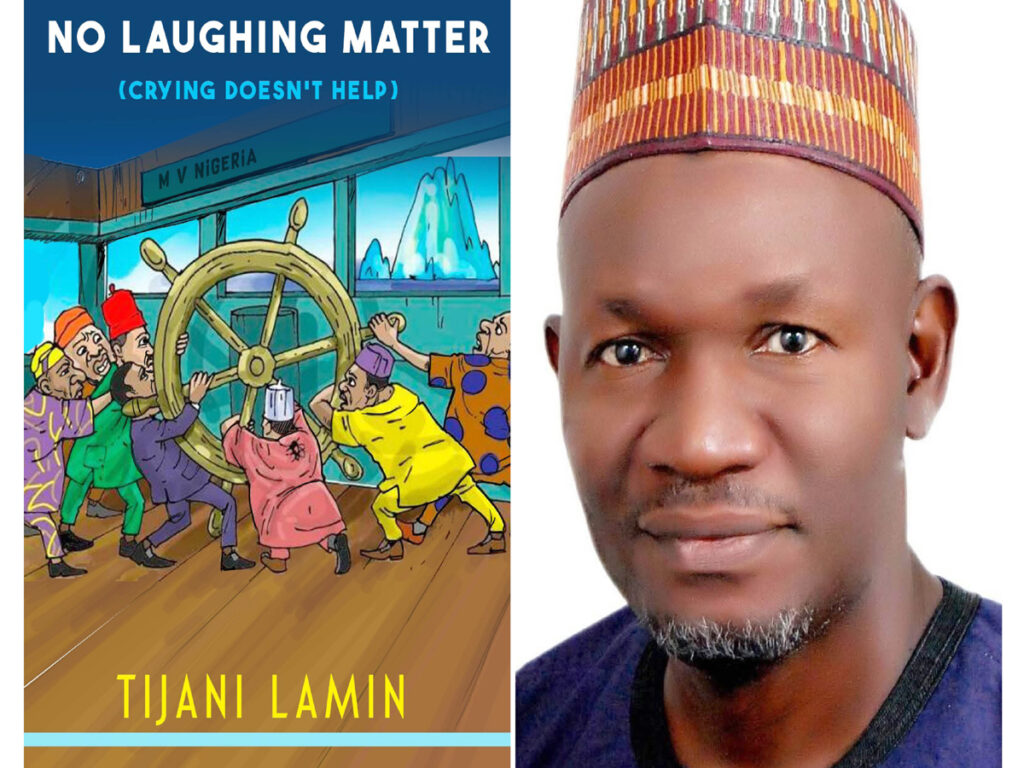

A drunk man staggers through an alley somewhere in Nigeria, singing to no one: “Boy, when you have nothing, you’ve got nothing to lose.” His voice echoes off the walls, fading, as Tijani Lamin’s narrator notes, “in decreasing amplitude as he disappeared into his shack.” That phrase, with its clinical scientific detachment applied to a man vanishing into poverty, tells you almost everything you need to know about No Laughing Matter: what looks like a joke is doing the work of an elegy, and what sounds like detachment is a disguise for something that cannot bear to be sentimental.
This is a book written in full knowledge that Nigeria’s condition is, depending on the angle, both completely absurd and completely tragic. The only fitting literary response, Lamin seems to say, is to refuse to choose between the two.
No Laughing Matter follows Justice Trifler, narrator and national conscience, who begins the novel at a jogging field in New Bussa where he encounters a stranger named Kamuzo Bango. Their first conversation, casual then philosophical then quietly despairing, opens a book that expands outward to encompass the whole machinery of Nigerian dysfunction: its corrupted elite, its failed institutions, its wasted oil wealth, its brilliant and exhausted ordinary people. What distinguishes Lamin’s novel from the many works of African political fiction that share these concerns is its formal conviction: a country this disordered cannot be described by a well-ordered book. The narrator’s digressions carry that conviction when they are working. When Trifler’s mind snaps from a jogging suit to the entire weight of national failure, or when a conversation about correspondence leaps to a forwarding address in the nineteenth province, each pivot feels driven rather than chosen, the narrator pursuing a thought he cannot abandon rather than a writer filling space. But not every digression earns this description. A late passage in which reflections on verb tenses dissolve into an inconclusive meditation on colonialism feels adrift rather than compelled, and the difference is immediately legible: a purposeful digression illuminates the thought that triggered it; an undisciplined one simply departs from it. The book has both. Recognising that distinction is the condition for understanding how much the better passages achieve, and how consistently those passages outnumber the weaker ones.
The book earns this ambition most fully in its satirical set pieces. The meeting at Central Fool’s Paradise is a gathering of officials that achieves nothing, presided over by a character whose very name, Mr. Kiss, is an acronym for Keep It Simple, Stupid. It demonstrates Lamin’s genius for a kind of comedy where the punchline and the indictment are structurally identical. When Mr. Kiss, the unlikely voice of reason in the chapter, suggests that “all we need to get us going is to know where we are going” and is received as if he has said something offensive, the reader laughs and winces in the same breath. The national conference scene operates by the same logic at greater scale. Dr. Samuel Habib, appointed sole researcher into public contentment, works alone for nine months, nine weeks, and nine days, and presents findings the size of a pocket diary. The president quotes Habib’s conclusion and immediately admits he does not know what it means. The proceedings conclude with a whistle produced from a jacket pocket and the announcement “Class dismissed, catch you folks later!” It is a moment of satirical timing so precise that the narrator wisely says nothing afterward. The silence is the joke.
At the human centre of this political architecture is the relationship between Trifler and Bango, the novel’s subtlest accomplishment. Bango is an original: a man who has spent forty years studying religion and politics only to conclude, with complete equanimity, that both systems produce rich leaders and poor followers, and who cannot decide whether to keep studying them. His periodic disappearances and returns — from Arabia, from war zones, from impossible journeys involving Patriot and Scud missiles navigated with the matter-of-fact calm of a budget traveller reporting minor flight delays — restore human scale to a narrative that occasionally loses itself in the weight of its own outrage. When Bango reappears “dusty, seedily dressed, and bearded all over, haggard,” arriving mid-meditation like an interruption Trifler pretends not to need but clearly does, the book remembers what it is: not a treatise, but a story about two men who love their country and cannot save it, who love each other and cannot reach each other.
The images that endure in this novel succeed because they trust the reader to make connections without being directed. On the beach at Myconos, Bango’s friend instructs him to kick a coin rather than pick it up, to avoid being assaulted for having it. The scene is pure physical comedy that is also a parable about the survival intelligence required simply to exist in public space in Nigeria. A three-year-old girl standing alone on stage after all the politicians have vanished behind the curtain, holding a placard reading “Trustworthy, Responsible, Accountable Individuals,” the acronym spelling TRAIT, delivers a verdict on Nigerian democracy more damning than any speech could manage. And Lola Akintola, a child at a presidential press briefing, asking when Nigerian children will have access to clean drinking water, while the Press Secretary opens a bottle of cold mineral water and pours himself a measure, is a juxtaposition so silent it requires nothing from the narrator, and receives nothing.
The pattern running through these three images is not accidental, and it reflects a deliberate choice about where to look for the book’s argument. Each image places the weight of national failure in the body or the silence of someone not yet equipped with the language to name what is wrong: a man whose safety depends on not drawing attention to what he carries, a girl holding a sign she may not fully read, a child who simply asks a question she should not have to ask. They are images of exposure: a country’s dysfunction made legible by the people least responsible for producing it. This is not the only way the book makes its case. The line delivered to a well-meaning Swiss woman at thirty-nine thousand feet — “We invested all the petro-dollars, or at least ninety per cent of it, in poverty, yes poverty. That is what we are reaping now” — works by an entirely different mechanism: an adult’s language catching up to his own grief, the comma before the second “poverty” performing the pause of a man who has just surprised himself with the accuracy of his bitterness. But the silent images and the compressed verbal ones are working toward the same destination. The book is building, from both directions, toward the same recognition: that the failure is not abstract, and the cost is being carried by people who did not incur it.
The novel’s structural challenges are real and worth naming. The transitions between modes, from scene to essay, from comedy to elegy, can feel abrupt in the middle sections, where Trifler sometimes disappears from his own narrative long enough that the reader misses his angle of vision. The catalogue of failed policies (the cement armada sinking in the harbour, Operation Feed the Nation, the Green Revolution collapsing into grey) accumulates weight without building shape. But the deepest challenge is in the epilogue, and addressing it requires first identifying what the book’s voice actually is.
At its best, that voice belongs to a narrator who refuses to settle. He laughs at what he loves. He coins language when existing words prove inadequate to the scale of the failure: “massness”, “ghettohood”, “political garlicking”. He corrects his own consolations in real time: writing “such is life” and immediately overruling himself: “No! Such is nonsense.” He holds fury and tenderness in suspension without letting either dissolve the other, and the suspension is maintained by restlessness, by a consciousness that will not arrive anywhere it can be comfortable. The epilogue abandons this. It pivots into policy proposals: a National Economic Action Council modelled on Malaysia’s, kindergarten civic values as the foundation for national renewal. These are reasonable ideas, but they are delivered in a voice that has finally settled, and the settlement is audible.
A book that has spent a hundred pages demonstrating that Nigeria’s failure is not a shortage of good ideas cannot afford to close in a register borrowed from the development report. The ironic self-awareness that would turn those proposals into the book’s final devastating joke — that would make the earnest list the sharpest thing in the epilogue — is exactly what is missing. The framework is there. The framing needs one more pass.
These are the frustrations of ambition, not of failure. No Laughing Matter belongs in the company of Voltaire and Armah, writers who understood that a novel’s form must enact its argument, not merely contain it. It is angrier than Tutuola, more comedically specific than early Soyinka prose, and more politically direct than either. The narrator who prays “God bless Nigeria and Nigerians, Amen” at the end of hundreds of pages of savage satire is not contradicting everything he has said. He is completing it. After all that wit and lament and absurdist invention, what remains is the most unguarded thing of all: a man who has looked at everything his country is, and still means it.
A book that opens in an alley with a man singing about having nothing to lose, and closes with a prayer for the country that produced him, has found the one structure large enough to hold both. Few satirical novels of any tradition earn their prayers. This one has.