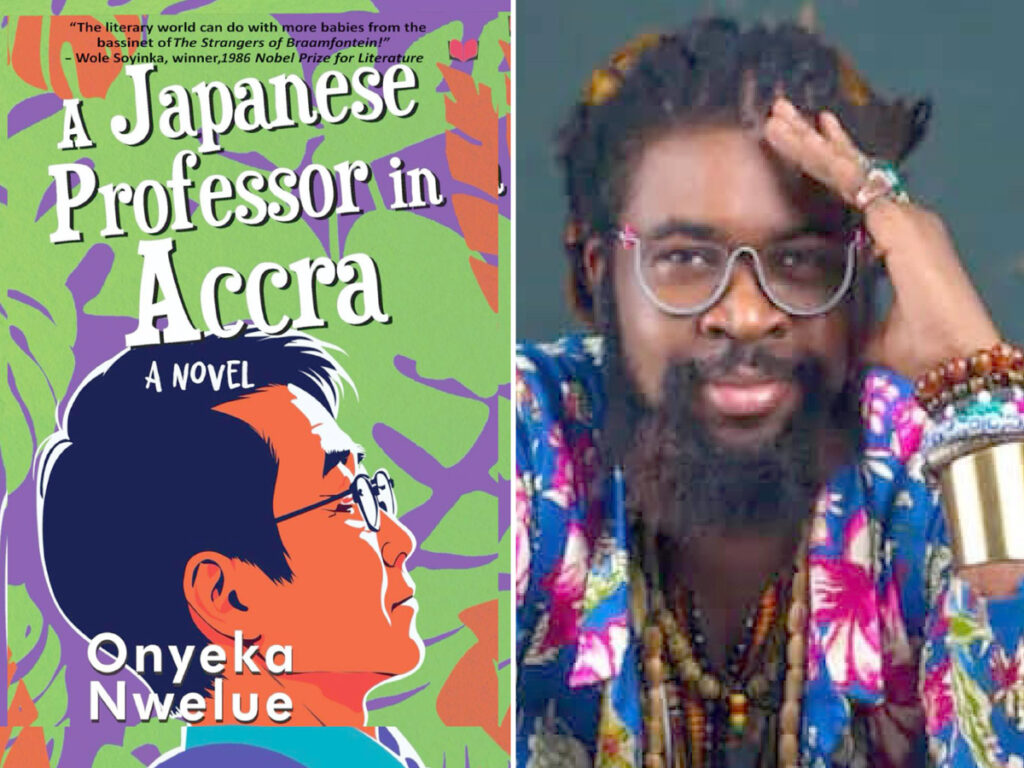

A Japanese Professor in Accra is a quiet, ambitious novel that blends storytelling with cultural reflection and medical awareness. The book centres on Professor Hideki Suzuki, a Japanese endocrinologist, whose visit to Ghana begins as a professional assignment but gradually becomes a deeply personal and transformative experience. What initially appears to be a simple narrative about travel and medicine unfolds into a meditation on identity, illness, entity, and the fragile connections between cultures of two continents.
Onyeka Nwelue uses this unlikely journey to explore not only the realities of diabetes, the care and the danger, but also the ways people understand themselves and others in a globalised world.
What makes this novel stand out is its unusual fusion of fiction and public health discourse. Rather than presenting diabetes as abstract medical information, Nwelue embeds it within human stories — patients, conversations, observations — and makes the subject immediate and emotionally resonant. This approach transforms the novel into something more than a narrative; it becomes a subtle form of advocacy for those living with diabetes.
Equally compelling is the cross-cultural dynamic at the heart of the book. By placing a Japanese professor in Accra, the Author creates a narrative lens that is both curious and unfamiliar. The city is not exoticised, nor is it simplified. Instead, it is rendered as a complex, living environment, full of contradictions and vitality.
Through Suzuki’s eyes, readers encounter Accra in a way that feels both fresh and grounded, allowing the novel to challenge stereotypes while celebrating cultural nuance in a way that leaves the reader wanting more of what the book can offer.
Several moments in the novel carry particular weight in shaping its themes. Suzuki’s arrival in Accra establishes the perspective of an outsider navigating a new cultural space. This moment is important because it frames the rest of the narrative: everything that follows is filtered through a consciousness that is learning, observing, discovering, adjusting, and sometimes misunderstanding.
The interactions with patients and medical professionals are central to the book’s emotional core. These scenes reveal that illness is never purely biological; it is shaped by culture, belief, and the circumstances surrounding the patient. Through these encounters, Onyeka humanises diabetes, presenting it as a lived experience rather than a clinical condition.
Moments of cultural disorientation in everyday settings like markets or social gatherings highlight the gaps between expectation and reality. These scenes are not played for humour alone; they serve to deepen Suzuki’s internal transformation. By the time the novel reaches its later stages, his perspective has shifted significantly, moving from detached observation to genuine engagement.
Ultimately, the most important “event” in the novel is not external but internal — the gradual redefinition of the protagonist’s understanding of life, health, and the connection between wellness and illness.
The novel follows a linear structure, but it is driven more by reflection than by plot. It begins with a clear objective, Suzuki’s professional visit to Ghana and gradually expands into a broader exploration of culture, tradition and human connection.
The early chapters are grounded in academic and medical concerns, giving the narrative a sense of purpose and direction. As the story progresses, it becomes more immersive, allowing the reader to experience Accra alongside the protagonist. The pacing is steady, sometimes deliberately slow, mirroring the process of observation and understanding.
By the final chapters, the narrative shifts toward introspection and resolution. Rather than offering dramatic closure, Onyeka opts for a quieter ending that emphasises growth and awareness. This structure reinforces the idea that the journey itself, not any single event, is the true focus of the novel.
Onyeka’s voice is brilliant, measured, observant, and reflective. He writes with a calm authority, allowing scenes to unfold without excessive dramatisation. There is a journalistic clarity in his prose, particularly in how he handles medical information, but this is balanced by a literary sensitivity to place and character.
The tone is often contemplative, inviting readers to think rather than react. At times, the narrative voice feels almost detached, mirroring Suzuki’s own initial distance from his surroundings. As the novel progresses, however, this distance softens, and the voice becomes more emotionally engaged.
One of the novel’s greatest strengths is its interdisciplinary approach. By combining fiction with health awareness, Nwelue creates a work that is both informative and emotionally compelling. The portrayal of Accra is another major strength, offering a nuanced depiction that avoids cliché.
The novel also excels in its subtle emotional resonance. Rather than relying on dramatic events, it builds meaning through small, cumulative moments. This understated approach gives the story a quiet power, allowing its themes to linger.
Despite its strengths, the novel is not without its limitations. The didactic elements, particularly those related to health education, can sometimes feel overly pronounced, momentarily disrupting the narrative flow.
The pacing may also be a challenge for some readers. The emphasis on reflection over action means that the story can feel slow, especially in sections where external conflict is minimal. Additionally, the relative lack of dramatic tension may leave readers who prefer plot-driven narratives wanting more.
You should read A Japanese Professor in Accra if you appreciate thoughtful, idea-driven fiction that explores real-world issues through a literary lens. It is especially rewarding for readers interested in culture, tradition, health, and the human condition.
A Japanese Professor in Accra is a novel that prioritises reflection over spectacle. Through the journey of Professor Suzuki, Onyeka Onwelue crafts a story that bridges continents, disciplines, and perspectives. It is a book that asks readers to slow down, to observe, to meditate, to ask, and to reconsider what it means to truly understand another culture or even oneself. Its strength lies not in dramatic twists, but in its ability to quietly reshape the way we see the world.
‘A Japanese Professor in Accra’ (literary fiction, 400 pages) by Onyeka Nwelue. Published in 2025 by Abibiman Publishing.
John Chizoba Vincent is a Nigerian filmmaker, screenwriter, cinematographer and film director. He lives and writes from Lagos, Nigeria. When he is not busy, he tweets @Jchizobavincent and posts random pictures of his production on IG @Jchizobavincnet.