
There is a voice in this collection that is difficult to locate in contemporary poetry because it refuses the categories that contemporary poetry tends to offer. It is not the detached, ironic voice of the Western-educated cosmopolitan. It is not the earnest, declarative voice of the political activist. It is not the nostalgic voice of the exile looking homeward. It is something stranger and more useful than any of those — a voice that is simultaneously inside and outside everything it describes, seduced by what it critiques, grieving what it loves, funny when you least expect it, and carrying, underneath all of it, a spiritual seriousness that it never quite announces but never abandons.
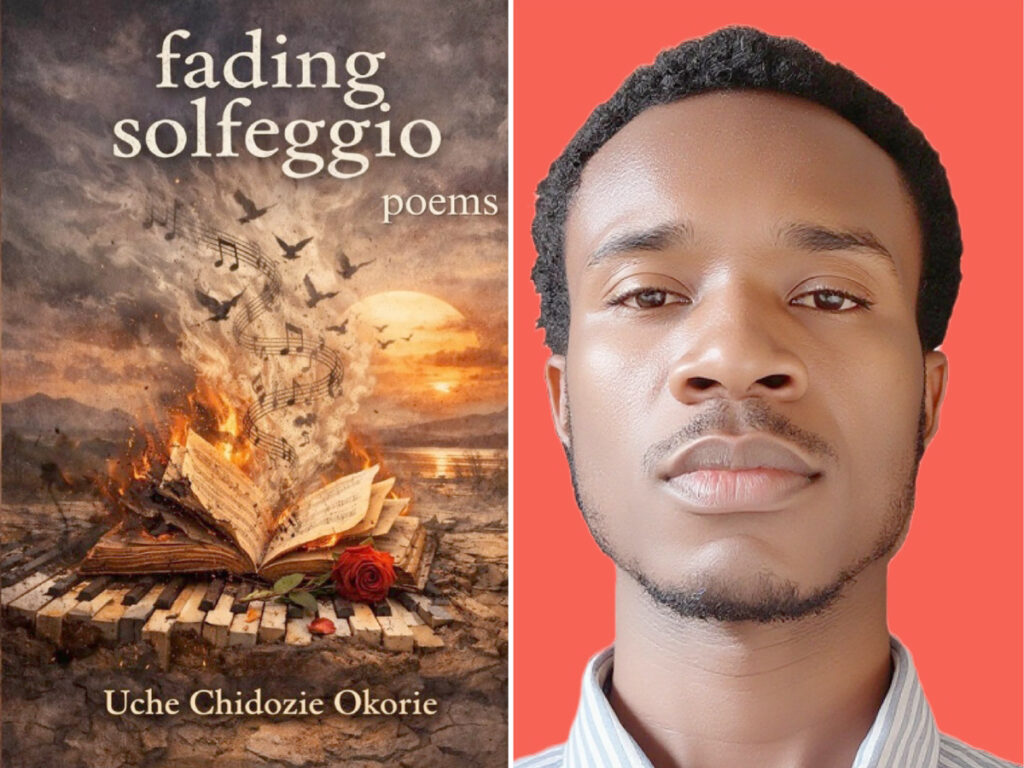
Uche Chidozie Okorie, in Fading Solfeggio, has built a whole cosmology out of this voice. It is an impressive and necessary piece of work.
The collection moves across seven sections — Chambers of My Soul, Dementia, Smoking Hills, Space Stations, Countries of Particular Concern, Fading Solfeggio, and Sweet Smelling Sacrifice — and the architecture is not decorative.
It is the book’s central argument made structural. The work opens inside one man’s anxious interior and moves progressively outward: through the body and what we feed it, through the natural world and what we are destroying, through the digital world and what it is doing to attention and love, through the political order and its machinery of suffering and exclusion, before turning, in its final movement, back inward again. But the man who arrives back at himself in the closing poems is not the same man who left. He has been changed by everything he witnessed, and he offers that change — his writing, his thinking, his very brain — as a deliberate gift to whoever comes after.
That gesture, “I burn my brain as a sweet-smelling sacrifice for this generation / Let them start where I stopped / Let them live where I died,” is the book’s thesis in its most distilled form, and it earns its weight because the preceding six sections have shown us, specifically and at length, what the burning costs.
The opening section establishes the collection’s central formal intelligence early. “The Worst Poem” — which is, conspicuously, quite good — performs the chaos it claims to embody. When the speaker writes that he “lynch[es] letters and stab[s] sentences / Slice[s] logic with a blunt knife into a tasteless recipe,” the violence turned inward produces a strange authority: you trust a voice that cuts itself open more than you trust one that only ever cuts others. This self-implication is one of Fading Solfeggio‘s most consistent and valuable qualities. It runs through every section.
The speaker warning about digital addiction is also checking his own notification bar. The speaker mourning the decline of authentic music is also writing in a world saturated by the noise he mourns. The critic is also the patient, and Okorie never lets either role off the hook. That honesty is not a flaw. It is the book’s moral spine.
The Dementia section is more varied than it might first appear — it contains the existential anguish of ‘Plate of Porridge’, the satirical edge of the title poem, and the self-examination of ‘A Bitter Poet’, alongside its better-known nature poems. But the poems about natural healing and indigenous knowledge are where the section’s civic vision most quietly announces itself. On the surface, ginger, moringa, and the vinegar plant are health choices. Look closer, and they are arguments — about what has been systematically replaced, what profits from the replacement, and what remains available to those willing to look.
‘Moringa’ is the section’s finest poem, personifying its subject as a woman of extraordinary quiet power — “She is a vitamin in the venom / A folic grace to the forlorn” — abandoned beside a rubbish dump while men pass without seeing. The poem ends on those oblivious men rather than on the moringa herself, which is the right call: the indictment lands on us, not on her, and we feel it more for that.
Smoking Hills contains Okorie’s most formally disciplined polemical work. ‘Ada’ — in which a forest is both an ecosystem and a woman, violated by timber scavengers — trusts its central image completely enough never to explain it. The word “Raped” arrives in the poem without preparation or apology, and everything that follows — “bare and barren, / Soured and saddened” — performs its grief through plainness rather than elaboration. The poem does not ask you to feel sad about deforestation. It makes deforestation intimate and bodily and irreversible, and then it stops.
‘Jackpots’ achieves something similar: the irony is built into the central metaphor and allowed to indict itself without a verdict. Men dig for gold and uncork a flood. The poem does not say this is wrong. The image carries the moral and gets out of the way.
Not every poem in the collection maintains this discipline, and honesty requires saying so. One recurring habit, most visible in ‘Plate of Porridge’, ‘Stupidity’, and parts of ‘Dragonfly’, is the temptation to explain what an image has already shown. ‘Plate of Porridge’ builds a harrowing interior world — crocodiles in the blood, eyes pooling like the Mississippi — and then interrupts it with ‘No. I am not mad’.
The reader was not doubting. The reader was inside the vision. The reassurance breaks the spell and reminds us we are reading rather than experiencing, which is the last thing a poem of that ambition wants. This is a pattern, not an isolated slip, and it is the one habit standing between several very good poems and great ones. The good news is that it is entirely a matter of nerve rather than ability, and the strongest poems here demonstrate, repeatedly, that the nerve is there.
Space Stations, the technology suite, is the collection’s most tonally adventurous, and its strongest poems work because the speaker cannot fully exempt himself from what he is criticising. ‘iPhone’ opens with a seduction sequence — “She steps closer… Closer, with a tempting red apple / I unintentionally sin righteously with a bite” — that establishes the smartphone as forbidden fruit before the poem has named what it is describing. The oxymoron “unintentionally sin righteously” is a small masterpiece of compression: it captures exactly the moral condition of modern technology use — we know, we do it anyway, and somehow it feels like both transgression and inevitability simultaneously.
‘Electromagnetic’ sustains an extended argument across multiple stanzas without losing its emotional thread, moving from cultural critique through grief to the quietly devastating admission: “Yet a little while, I sound jealous.” A man confessing jealousy of a phone. That line is simultaneously funnier and sadder and more honest than a hundred earnest essays about screen addiction, and it rescues the poem from lecture by returning it to human truth.
The section’s single greatest line, though, belongs to ‘WASSCE’, a poem about AI doing students’ homework: “How do I save you from this wonderful life?” The word wonderful carries both meanings at once, without flinching from either, and that double-weight is Okorie operating at full capacity.
‘Coming to America’, in the ideological section, is the collection’s most fully realised single poem and probably its most important. It is genuinely funny — “Operation high jump, such a wasted Olympic talent” — while carrying, underneath every joke, a portrait of something that is not funny at all. The speaker performs innocence for an immigration authority that has already decided: the reverend father’s lineage, the declaration that he is “allergic to misbehaviour,” and the assurance that he has no address for Captain Jack. What the poem understands, and what makes it remarkable, is that this performance of harmlessness is itself a form of humiliation, a dignity pre-emptively surrendered at a border staffed by people who were never going to be moved by it anyway. The poem signs off as “Yours sincerely, green card,” and the reader laughs and winces at the same time, which is exactly the response the poem has been building toward.
What holds all seven sections together, and what deserves to be named clearly, is the deep spiritual architecture that runs beneath the whole. This is an intensely devotional book, built from multiple traditions simultaneously: the work references Pentecost, the Euphrates, Golgotha, the sweet-smelling sacrifice of the Old Testament, and something older and more local that the poems call mysticism without defining. These references are not decoration borrowed from religion. They are structural to the book’s entire understanding of what writing is for.
When the final poem burns the speaker’s brain as a sweet-smelling offering, it is enacting a theological conviction — that creative work is a form of sacrifice, and sacrifice costs something real — that has been present from the first poem. That consistency of sacred seriousness underneath the intellectual and ideological range of the work is what gives Fading Solfeggio its unusual depth of field.
The collection is not without real limitations. The transition from the accumulated grief of Countries of Particular Concern and Fading Solfeggio into the redemptive opening of Sweet Smelling Sacrifice happens slightly too quickly — the reader can feel the seam where one emotional register hands off to another without quite enough breathing space between them.
A few poems in the ideological section, ‘Poor Rich Fellas’ and parts of ‘Very Important Position’, make their arguments through direct assertion in places where the book’s stronger instinct would have reached for an image instead. These are genuine gaps, and naming them is not a diminishment of the work. It is a recognition that the ambition here is large enough that the weaknesses are worth taking seriously.
Okorie’s preface describes this work as “my rough journey to the moon” and then adds, with the kind of plainness that is harder to achieve than any elaboration: “I take it.”
He takes it. The moon is not yet reached. But the direction is unmistakable, and the ground covered is real.
Fading Solfeggio (Poetry, 129 pages) by Uche Chidozie Okorie. Published in 2026 by Literary Dungeon Publishers.