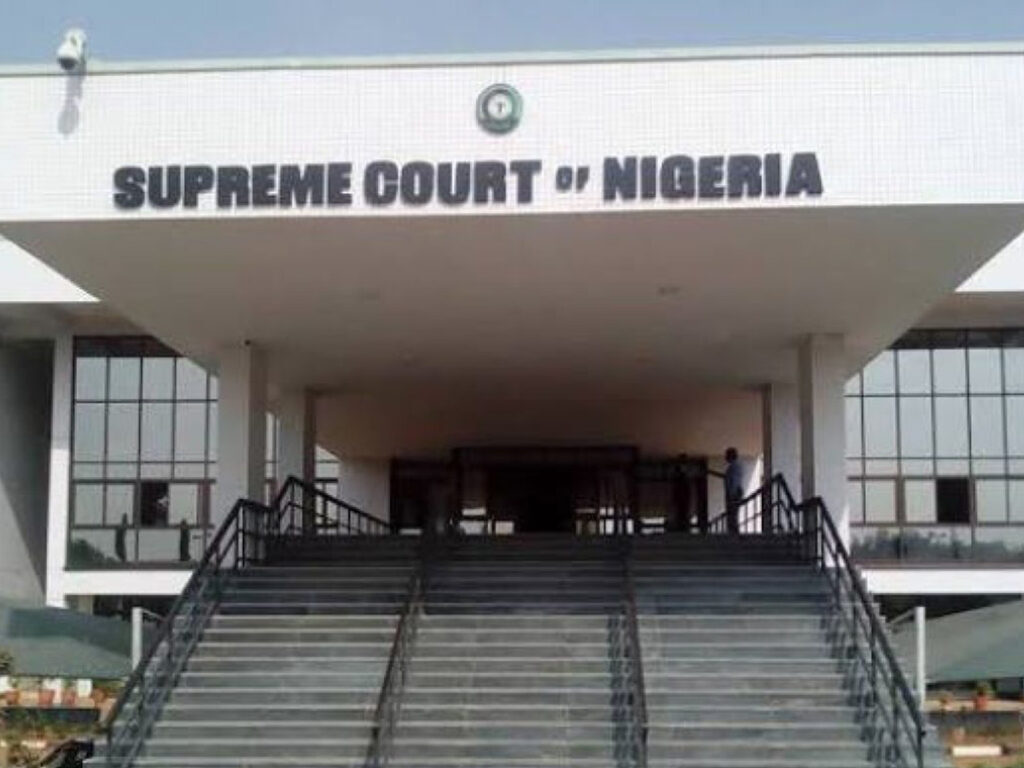

The Supreme Court of Nigeria has confirmed that the president has constitutional authority to declare a state of emergency in any state to avert the collapse of law and order or prevent descent into disorder.
The apex court also ruled that, within such a period, the president may suspend elected officials, provided the suspension is limited in duration.
The ruling stems from a legal challenge brought by Adamawa State, joined by ten other states governed by the Peoples Democratic Party (PDP).
The states contested President Bola Tinubu’s emergency declaration in Rivers State in March 2025, during which Governor Siminalayi Fubara, his deputy, and members of the state assembly were suspended for a six-month period.
Delivering the lead judgment for the six-to-one majority, Justice Mohammed Idris explained that Section 305 of the 1999 Constitution grants the president the discretion to take extraordinary measures necessary to restore normalcy where a state of emergency has been declared.
The judge noted that the constitution does not specifically define the scope of these measures, giving the president latitude to determine the appropriate course of action.
Justice Idris highlighted past instances since the return of democratic governance in 1999 where states of emergency were declared, and elected officials were either suspended or retained depending on the circumstances.
He maintained that the six-month suspension of the governor and other officials in Rivers State, along with the appointment of a sole administrator, was within the president’s constitutional powers.
The lead judgment also addressed the role of the National Assembly in approving the emergency declaration, noting that the use of voice votes by legislators was lawful. Justice Idris emphasised that the Legislative Houses (Powers and Privileges) Act grants the National Assembly discretion to determine voting procedures in such matters.
The Supreme Court considered the suit, marked SC/CV/329/2025, which had been filed by the Attorneys-General of Adamawa, Enugu, Osun, Oyo, Bauchi, Akwa Ibom, Plateau, Delta, Taraba, Zamfara, and Bayelsa states.
The plaintiffs had sought clarification on whether the president could lawfully suspend governors, deputy governors, and members of state assemblies, and whether the procedures for declaring the emergency in Rivers State adhered to constitutional provisions.
Justice Idris upheld preliminary objections raised by the Attorney-General of the Federation and the National Assembly, ruling that the plaintiffs had failed to establish any cause of action that could activate the Supreme Court’s original jurisdiction.
He pointed out that three conditions must be met for the court to exercise original jurisdiction: there must be a dispute between the federation and one or more states or among states, the dispute must involve issues of fact or law, and the dispute must relate to a legally exercisable right.
The court observed that the plaintiffs did not demonstrate that the emergency in Rivers State directly affected them or that they were authorised by the state to file the suit on its behalf. Consequently, the court struck out the suit for lack of jurisdiction. However, the justices proceeded to consider the merits and dismissed the case entirely.
Justices John Okoro, Chioma Nwosu-Iheme, Haruna Tsammani, Stephen Adah, and Habeeb Abiru joined Justice Idris in the majority decision.
Justice Obande Ogbuinya dissented, arguing that while the president can declare a state of emergency, this power does not extend to suspending elected officials, including governors, deputy governors, and legislators.
The emergency rule in Rivers State, declared in March, was formally lifted in September 2025, restoring Governor Fubara and other elected officials to their offices.
The Supreme Court’s ruling is expected to set a precedent on the extent of presidential powers during emergencies and clarifies the legal limits of suspending elected state officials.